
Meadow High School
Therapies
Therapy at Meadow
At Meadow, therapy is integrated into the curriculum and is part of everyday learning. It helps students feel safe, regulated, and able to communicate, learn, and interact confidently.
Our team of Speech and Language Therapists, Occupational Therapists, and Therapy Assistants work closely with teachers, families, and external professionals to provide consistent, holistic support. Strategies are embedded in classrooms, ensuring that therapy strengthens learning rather than sitting separately.
At Meadow, we use a three-tier approach to make sure every child receives the right level of support. This model is informed by students’ Education, Health and Care Plans (EHCPs), where applicable, as well as by assessments, observations, and ongoing assessment of need.
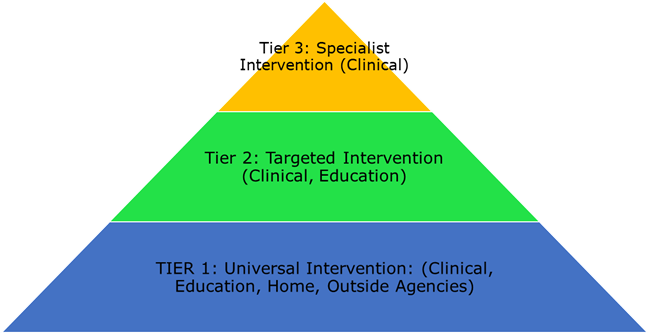
Universal support is in place for all students. Every classroom is structured, predictable and communication-friendly, helping children feel safe and ready to learn. Students are supported at an individual level using a holistic approach, and staff receive ongoing training in therapeutic strategies, ensuring support is embedded in daily practice across the school.
Targeted support is provided for students who need additional help in specific areas. This usually involves small-group or short-term interventions delivered by therapists and trained staff. Skills developed in these sessions are practised in the classroom and throughout the school day to support generalisation and independence.
Specialist support is provided for students with specific needs identified in their EHCPs. This includes individual assessment and one-to-one therapeutic intervention delivered by qualified therapists. Targets and strategies are then shared with classroom staff so they understand what is being worked on, why it is important, and how to support progress throughout the day.
Our approach is holistic and joined-up, with therapy integrated throughout the school day and shared across staff and families. Ongoing staff training ensures strategies are used consistently, supporting students to develop communication, emotional regulation and independence.
We recognise that communication, sensory needs, movement and emotional understanding are closely linked. When these areas are supported well, students feel calmer, more confident and better able to engage in learning.
Our Roles and Responsibilities
Speech and Language Therapy (SaLT)
Our SaLT team supports students to:
- Understand and process spoken language
- Express themselves clearly
- Develop emotional and social vocabulary
- Build narrative, reasoning, and pragmatic skills
- Use communication effectively in daily life
- Vocational skill development – Life after Meadow
SaLT is delivered through both individual and group sessions and is embedded into classroom practice. Strategies are modelled with staff so that communication support is consistent throughout the school day.
Occupational Therapy (OT)
Our OT team supports students to participate fully in school life, focusing on:
- Sensory processing and regulation
- Fine and gross motor development
- Postural stability and coordination
- Functional independence
- Environmental adaptations
- Vocational skill development – Life after Meadow
OT input is provided through direct intervention, classroom adjustments and co-regulation supports, and staff guidance. This ensures that students can access learning, regulate effectively, and develop skills for independence.
Therapy Assistant Support
The Therapy Assistant works alongside qualified therapists to deliver structured programmes, reinforce strategies, and support consistency between therapy sessions and classroom learning. Resource making and training in class is also part of this role.
Physiotherapy at Meadow
At present, physiotherapy support at Meadow is provided by the Trust for students with an identified health need. Access to physiotherapy is guided by each student’s Education, Health and Care Plan (EHCP) and clinical recommendations.
Support is needs-led and may include advice, programmes and training for school staff, enabling strategies to be embedded safely and consistently within the school day. We work closely with external health professionals to ensure physiotherapy input is appropriate, purposeful and supports students’ physical wellbeing and access to learning.
Holistic Multidisciplinary and Transdisciplinary Working
At Meadow, we take a holistic view of each student. No single difference exists in isolation. Our approach considers the child’s strengths, challenges, environment, and relationships.
Therapy is delivered in both multidisciplinary and transdisciplinary ways. This means:
- Therapists collaborate with teachers, pastoral staff, families, and external professionals to coordinate support.
- Knowledge is shared across the school. Therapists model strategies, coach staff in real time, and embed skills throughout the school day.
- Education and therapy are integrated, ensuring that learning is accessible and consistent.
Staff Training and Capacity Building
Staff development is a core part of our model. Therapists provide ongoing training, modelling, and reflective practice sessions to build staff confidence and competence. This ensures that strategies are consistently applied universally across classrooms and that therapeutic approaches become part of everyday practice.
Our Aim
The ultimate goal of therapy at Meadow is to help students develop the skills they need to succeed in school and beyond. This includes:
- Effective communication in all forms (using sign, verbal speech, visual aids)
- Emotional regulation
- Independence and functional skills
- Confidence to engage in learning
- Skills to navigate social and emotional challenges
Therapy at Meadow is integrated and designed to build skills in both students and staff. By embedding therapy across the school day, we create a supportive environment where every student can thrive.